Customs Broker for China Imports: What They Do and When You Need One
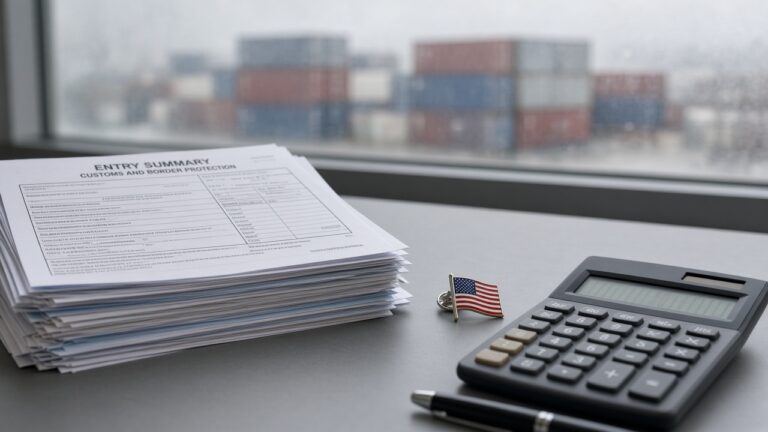
A customs broker is a licensed professional who files import declarations on your behalf, pays duties and taxes from your account, and communicates with customs authorities when queries arise. For regular China imports, using a licensed customs broker is not just convenient — in many cases it is a legal requirement for the importer of record to appoint one.
Key facts at a glance
• In the US, customs brokers must hold a CBP (Customs and Border Protection) licence; in the UK, a customs agent must be authorised to act under HMRC procedures; in the EU, each member state has its own authorisation requirements for customs representatives
• Customs broker fees for a standard FCL sea shipment from China typically range USD 150–350 for entry filing in the US, or £150–300 in the UK — plus any disbursements (duty, VAT) collected on your behalf
• The importer of record is always legally responsible for a correct entry — the broker acts as your authorised agent, but you bear the liability for errors, underpaid duty, and incorrect classifications
• Using the same broker as your freight forwarder is convenient but not always optimal — dedicated customs brokers without a freight operation sometimes provide more attentive classification advice
What a customs broker does for a China import
- Tariff classification: assigns the correct HS/HTS/CN code to your goods — the most consequential decision in the customs entry, since it determines the duty rate and any additional trade measures (Section 301, anti-dumping)
- Entry filing: prepares and submits the import declaration to customs authorities (CBP in the US, HMRC in the UK, national customs in the EU) with the supporting documents (commercial invoice, packing list, bill of lading, certificate of origin)
- Duty and tax payment: calculates import duty, VAT/GST, and any additional tariffs; collects the amount from you and pays it to customs on your behalf
- Customs examination liaison: if customs selects your shipment for examination (physical inspection or document review), the broker handles the interaction and coordinates access to the goods at the port
- Post-entry work: handling customs queries, filing post-entry amendments if errors are found, and managing any drawback claims on duties paid
Customs broker requirements by destination market
Send your product information to the broker before your first shipment
A good customs broker will ask for a detailed product description, composition, intended use, and HS code before your first shipment. If they don’t, provide it anyway — the more information they have, the better the classification decision. For China imports subject to Section 301 or anti-dumping duties, a few minutes of upfront communication about the product can prevent an unexpected 25% additional duty charge at clearance.
The importer of record cannot delegate legal liability to the broker
Customs brokers are agents — they act on your behalf, but the legal obligation to pay the correct duty and comply with import regulations rests with the importer of record (you, or your company). If your broker misclassifies your goods, undervalues them, or fails to declare goods subject to import permits, you are liable — not the broker. For product categories with complex classification or trade measure exposure, ask your broker for written classification opinions that document the reasoning, and review them before the first entry.
Frequently asked questions
Need help finding a licensed customs broker for your China import route? MandarinDesk can connect you with experienced customs professionals in the US, UK, and EU. Contact us.
How Do You Find a Customs Broker?
- Ask your freight forwarder: Most freight forwarders either provide customs brokerage services themselves or have preferred broker partners. If you are already working with a forwarder for the China-to-destination leg, ask them.
- National customs broker associations: In the US, the National Customs Brokers and Forwarders Association of America (NCBFAA) has a directory. In the UK, the British International Freight Association (BIFA) lists members.
- Referrals from other importers: If you know other businesses that import from China in your industry, their broker recommendation is often the most reliable starting point.
Related reading
Need a hand?
Tell us what you need done in China. We reply within 24 hours with a fixed price and timeline.
Get a free quote →