During Production Inspection (DUPRO): How to Monitor a China Factory While Your Order Is Being Made
A during production inspection catches defects and deviations while the factory can still correct them — not after every unit has been made. Here is when to request one and what it checks.
Key facts at a glance
• A during production inspection (DUPRO) takes place when 20–40% of your order is complete
• It catches systematic defects early, when corrective action is still feasible without full rework
• Cost: typically $200–$350 for a one-day visit in China
• Also called: mid-production inspection, in-process inspection, inline inspection
• Most valuable for: large orders, complex products, factories with previous quality issues
What is a during production inspection?
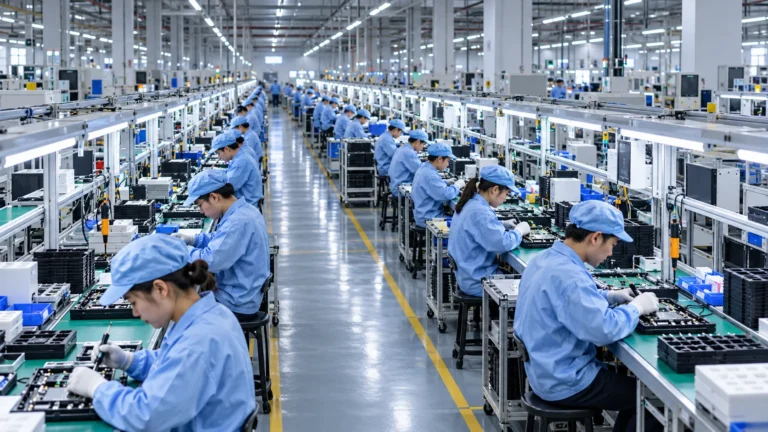
A during production inspection (DUPRO) is a quality check performed while your order is in active production — typically when 20–40% of units have been completed. An independent inspector visits the factory, examines a sample of finished-to-date units, checks in-process work on the production line, and verifies that production is proceeding in line with your specifications.
The defining advantage of DUPRO is timing. When an inspector identifies a defect in 20% of your order, the factory can adjust its process, retrain workers, or replace tooling before the remaining 80% is produced. Finding the same defect at the pre-shipment inspection — when 100% is finished — typically means rework, re-production, or shipment delay.
When in production does a DUPRO happen?
For very large orders (5,000+ units) or high-risk products, some buyers schedule two DUPRO visits — one at the 20% mark and one at the 60% mark — in addition to a final pre-shipment inspection.
What does a DUPRO check?
- Finished units: A statistical sample using AQL standard sampling — inspector checks dimensions, appearance, function, and workmanship against your specifications and the golden sample
- In-process units: Units currently on the production line, checked for assembly consistency and common recurring defects
- Defect classification: Each finding categorized as critical, major, or minor per your AQL criteria
- Packing and labeling: Carton markings, inner packing, barcodes verified — packaging errors caught early are easy to fix
- Production rate vs schedule: Is the factory on track to complete your order by the agreed date?
- Special requirements: Any product-specific test points from your specification sheet or previous inspection reports
What are the most common defects found during DUPRO?
- Consistency drift: Units produced on day 10 look slightly different from units produced on day 1 — color, finish, or dimensions gradually shift as production runs
- Wrong component substitution: Factory ran out of a specified component and substituted without informing the buyer
- Packing errors: Wrong quantity per carton, missing manuals, incorrect barcodes — these accumulate through the entire run if not caught early
- Workmanship decline: Quality drops as workers settle into repetitive production, particularly after the first week
- Schedule slippage signs: Factory is running late and may not meet shipping date — DUPRO is often the first indicator
How to trigger a DUPRO at the right time
Ask your factory to notify you when 20% of units are complete, so you can schedule the inspector. Many factories will not proactively alert you — build this notification requirement into your purchase order terms. At MandarinDesk, we track production milestones and schedule inspections on your behalf without requiring you to chase the factory.
DUPRO vs pre-shipment inspection: do you need both?
They serve different purposes and are complementary:
- DUPRO catches problems while they can be corrected cheaply. Its value is in prevention.
- PSI gives you a final pass/fail decision on completed goods before they ship. Its value is in final verification.
For small, low-risk orders with trusted factories, a PSI alone is often sufficient. For large orders, new factories, technically complex products, or orders with previous issues, DUPRO + PSI provides meaningful additional protection at a combined cost of $400–$700 — a small fraction of most order values.
DUPRO does not eliminate the need for a pre-shipment inspection
A passing DUPRO means production is on track at the midpoint — it does not certify the final shipment. Always combine DUPRO with a pre-shipment inspection (PSI) on 100% completed goods before approving loading. The PSI remains your last line of defense.
Frequently asked questions
MandarinDesk coordinates during production inspections throughout China and provides detailed photo reports within 24 hours. We track your production schedule and alert you when units are ready to inspect, so you do not have to chase the factory for updates. Contact us to add DUPRO to your quality control plan.
Related reading
Need a hand?
Tell us what you need done in China. We reply within 24 hours with a fixed price and timeline.
Get a free quote →