Vietnam vs China Manufacturing: Which Is Better for Your Product in 2026?
Many brands and importers have been asking whether to shift production from China to Vietnam — driven by tariff pressures, rising Chinese wages, and a desire to diversify their supply chain. Vietnam has genuine strengths as a manufacturing base, but China has advantages that Vietnam cannot currently match across most product categories. This guide compares the two countries honestly so you can make an informed decision.
Why Are Buyers Considering Vietnam Instead of China?
The main reasons buyers have explored Vietnam manufacturing in recent years are:
- US tariffs on Chinese goods: Section 301 tariffs imposed from 2018 added 7.5–25% to the cost of most Chinese imports into the United States. Vietnam does not currently face these tariffs, making Vietnam-made goods cheaper to import into the US for the same product.
- Rising labour costs in China: Chinese factory wages have risen significantly over the past decade, narrowing the labour cost advantage that made China so dominant in the 1990s and 2000s.
- Supply chain risk diversification: Concentrating all production in one country creates vulnerability to disruption from policy changes, natural disasters, or geopolitical events. Many buyers want a second source outside China regardless of cost.
- Ethical sourcing pressure: Some buyers face scrutiny from customers or investors over sourcing from China, particularly in categories linked to supply chain concerns.
Where Is Vietnam Genuinely Competitive?
Vietnam has built real manufacturing capability in a limited set of industries:
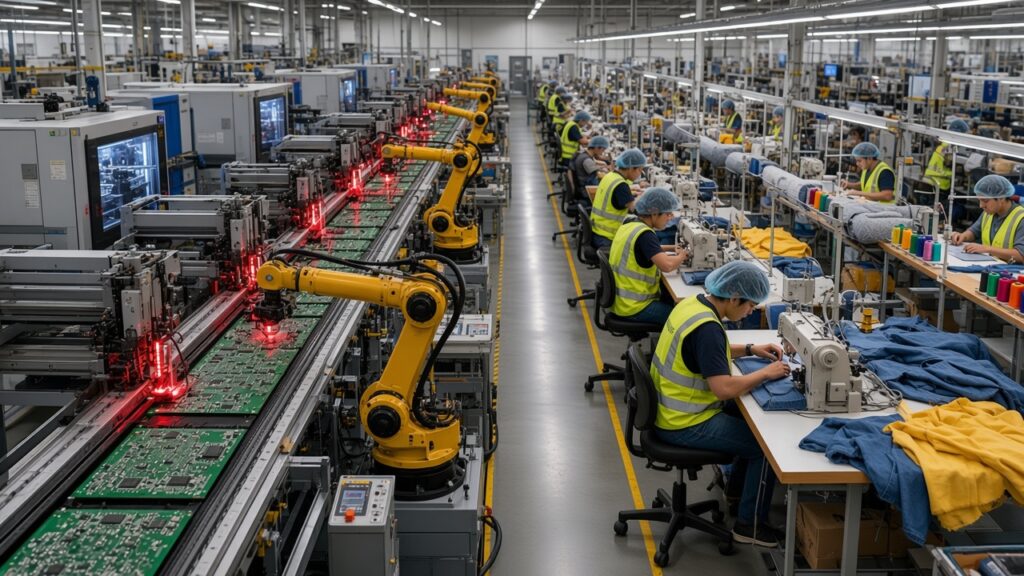
- Garments and footwear: Vietnam is the world’s second or third largest exporter of apparel and footwear. Labour costs are lower than coastal China, and the industry has decades of experience supplying international brands.
- Electronics assembly: Major electronics manufacturers (Samsung, Intel, LG) have built large production facilities in Vietnam. The country now exports significant volumes of smartphones, semiconductors, and electronic components.
- Furniture: Vietnam has become an important furniture manufacturing hub, particularly for wood furniture, partly driven by US buyers seeking to avoid Chinese tariffs on furniture.
- Simple consumer goods: For labour-intensive products with relatively simple manufacturing processes, Vietnam can compete on cost with Chinese coastal factories.
Where Does China Still Have the Advantage?
For most product categories, China maintains significant advantages over Vietnam:
- Supply chain depth: China has an unmatched ecosystem of component suppliers, raw material processors, tooling manufacturers, and logistics providers. For most products, every input can be sourced within China. Vietnam still imports most of its manufacturing inputs from China, which limits its true cost advantage and creates its own supply chain dependency.
- Manufacturing breadth: China manufactures almost everything. Vietnam manufactures competitively in a narrow set of categories. If your product is not garments, footwear, or simple electronics, the Vietnam option may not exist at the quality and quantity you need.
- Skilled workforce and technical capability: For precision manufacturing, complex assembly, or products requiring deep technical expertise, China’s larger industrial workforce and longer manufacturing history give it an advantage.
- Minimum order quantities and flexibility: Chinese factories are accustomed to working with international buyers at smaller volumes, with high customisation, and with tight timelines. Vietnam factories in many categories have higher minimum orders and less flexibility.
- Speed to market: China’s supply chain density means shorter lead times for most product categories. Vietnam’s longer supply chains (relying on Chinese inputs) can extend lead times.
What Does the Tariff Situation Actually Mean for Your Landed Cost?
Section 301 tariffs on Chinese goods add 7.5–25% to the cost of importing into the United States. This is significant, but it does not automatically make Vietnam cheaper once you account for the full picture:
- Vietnam factory prices may be higher than Chinese prices for the same product, particularly once you account for Vietnam importing inputs from China.
- Vietnam supply chains are less developed, which can mean longer lead times, higher freight costs from Vietnam ports, and less reliable quality control.
- Vietnam has its own tariff and trade policy risks — the US has scrutinised Vietnam for transshipping Chinese goods, and further trade actions are possible.
The correct analysis is: take the Chinese factory price, add the applicable tariff, compare that to the Vietnam landed cost including all freight and duties. For many buyers, the comparison is closer than expected — and in some categories, China remains cheaper even after tariffs.
What Is the “China Plus One” Strategy?
“China Plus One” refers to maintaining China as the primary production base while developing a second manufacturing source in another country — Vietnam, India, Bangladesh, Mexico, or elsewhere — to reduce concentration risk. This approach is more practical for most buyers than a complete shift away from China, because it preserves the efficiency and cost advantages of Chinese manufacturing while reducing vulnerability to China-specific disruptions.
For buyers at smaller volumes, maintaining two parallel supply chains is expensive and complex. The more pragmatic version is to identify a qualified Vietnam (or other country) supplier who could scale up production if needed, without actively splitting orders between the two.
How Should You Decide?
A structured approach:
- Calculate your true landed cost from China, including the applicable Section 301 tariff for your HTS code.
- Get quotes from Vietnam factories for the same product and calculate the Vietnam landed cost.
- Compare not just the price but the minimum order quantity, lead time, quality track record, and flexibility available from each option.
- Consider your volume: at smaller volumes, the complexity of managing a Vietnam supply chain may not justify the cost saving.
- Assess whether the saving is durable: Vietnam factory prices can change, and Vietnam’s own trade status with the US is not guaranteed.
If you are currently sourcing from China and want to benchmark whether the price you are paying is competitive before looking elsewhere, MandarinDesk’s Price Benchmark Check service searches 1688 and Alibaba for comparable listings and gives you a reference point for the domestic Chinese factory price.
Related reading
Need a hand?
Tell us what you need done in China. We reply within 24 hours with a fixed price and timeline.
Get a free quote →