What Is Lead Time in Manufacturing? A China Importer’s Guide
Lead time in manufacturing is the total time from placing an order to receiving the finished goods. When you order from a Chinese factory, lead time covers the period from the factory accepting your order and deposit to the goods being ready for shipment at the port of loading. It does not include transit time — the time the goods spend on a ship or plane on the way to your country. Understanding lead time is essential for inventory planning, launch scheduling, and cash flow management.
What Does Lead Time Mean When Sourcing From China?
When a Chinese supplier quotes a lead time, they typically mean the number of working days or calendar days from order confirmation (usually when your deposit is received) until the goods are ready at their factory or warehouse. It does not include:
- Shipping time from China to your destination (ocean freight typically adds 15–35 days depending on route and service)
- Customs clearance at the destination port
- Domestic delivery after customs
Your total time from order to goods-in-hand is lead time plus transit time plus clearance. For planning purposes, always add all three.
What Is a Typical Lead Time for Chinese Factories?
Lead times vary significantly by product type, order size, and factory workload:
- Stock or catalogue items (products already in production): 1–7 days
- Standard custom items (your branding on an existing product): 15–30 days
- New product development (new mould, unique design, first production run): 45–90 days
- Large or complex orders: 60–120 days
These are general ranges. Always confirm the specific lead time in writing with your supplier for each order, as factory capacity changes with season and order volume.
What Factors Affect Lead Time From China?
- Chinese New Year: Factories typically close for 2–4 weeks around January or February. Orders placed in the 4–6 weeks before CNY may be delayed as factories rush to clear backlogs or start late due to raw material shortages after the holiday.
- Golden Week: A 7-day national holiday in October causes similar (smaller) disruptions.
- Raw material availability: Some materials have their own lead times. A factory waiting for fabric, resin, or electronic components may not start production immediately after you place your order.
- Sampling rounds: If you require pre-production samples for approval, each round adds 7–14 days before mass production can begin.
- Factory workload: A busy factory during peak season (typically Q3, as buyers prepare for Christmas) may quote longer lead times than the same factory in January.
How Do You Reduce Lead Time When Ordering From China?
- Order early: The single most reliable way to meet deadlines is to build enough buffer into your planning. Work backwards from your required in-store date.
- Approve samples quickly: Delays in sample approval directly extend the total timeline. Have a decision process in place before samples arrive.
- Use stock or in-production items: Customising a product that is already in a factory’s standard range is much faster than starting from scratch.
- Pay the deposit promptly: Most factories do not start production until your deposit is received. Bank transfer times and processing delays can add days.
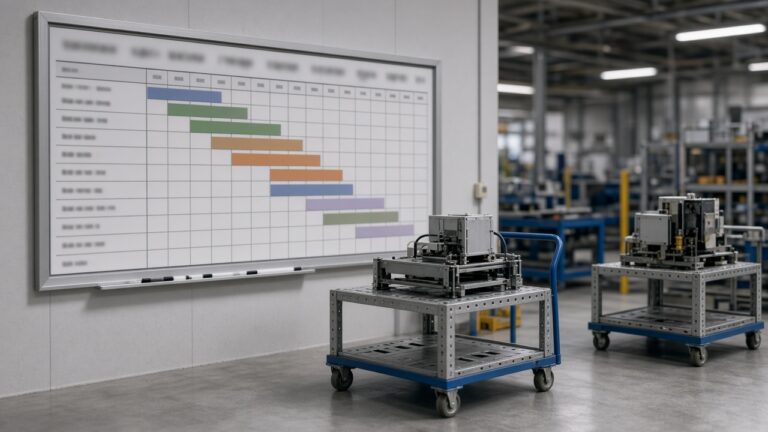
- Agree on a production schedule in writing: Ask for a week-by-week production timeline with key milestones, and have your agent or representative check progress at each stage.
What Is the Difference Between Lead Time and Production Time?
Production time refers specifically to the time spent manufacturing the goods — the time the factory has the material on the line. Lead time is the broader window that includes pre-production steps like material procurement, mould preparation, and scheduling. Lead time is always equal to or longer than production time. When a supplier quotes you “30 days lead time,” those 30 days include everything from order confirmation to goods ready for pickup — not just the time the goods are on the production floor.
How MandarinDesk Helps You Track Production Progress
One of the most common problems importers face is not knowing where their order actually is in the production process. Factories do not always proactively communicate delays, and language barriers make follow-up harder. MandarinDesk’s production tracking service monitors your order’s progress directly with the factory in Mandarin and gives you a weekly status update — so you know whether your goods are on schedule before it becomes a problem. See our guide to what a China sourcing agent does for the full picture of how ongoing supplier management works.
Related reading
Need a hand?
Tell us what you need done in China. We reply within 24 hours with a fixed price and timeline.
Get a free quote →