

What Is a Letter of Credit? Using LC When Importing From China
A letter of credit (LC) is a payment mechanism where a bank guarantees that a seller will receive payment, provided they present the correct shipping and trade documents within the agreed timeframe. It is used in international trade — including imports from China — when buyers and sellers do not have an established relationship and need a neutral financial intermediary to manage payment risk.
How Does a Letter of Credit Work?
The basic LC process in China import trade follows these steps:

- The buyer (importer) applies to their bank (the issuing bank) to open an LC in favour of the seller (the Chinese factory or supplier).
- The issuing bank sends the LC to a bank in China (the advising or confirming bank), which notifies the seller that the LC is in place.
- The seller ships the goods and gathers the required documents: typically the bill of lading, commercial invoice, packing list, certificate of origin, and any other documents specified in the LC.
- The seller presents these documents to the advising bank within the LC’s validity period.
- The advising bank checks the documents against the LC terms. If they comply, it forwards them to the issuing bank.
- The issuing bank makes payment to the seller (or accepts a time draft for deferred payment).
- The issuing bank releases the documents to the buyer, who uses the bill of lading to claim the goods at the destination port.
The key feature of an LC is that payment is made against documents, not against the physical delivery of goods. The bank pays when the correct documents are presented — it does not inspect the goods themselves. This means an LC protects the seller from non-payment but does not guarantee the buyer that the goods are as ordered.
What Are the Different Types of Letter of Credit?
- Irrevocable LC: Cannot be cancelled or changed without the agreement of both buyer and seller. Standard in modern trade; revocable LCs are almost never used.
- Confirmed LC: The advising bank in China adds its own guarantee of payment, in addition to the issuing bank’s. Used when the seller does not fully trust the buyer’s bank (for example, if the issuing bank is in a country with currency controls or financial instability).
- Sight LC: Payment is made immediately when compliant documents are presented.
- Usance (deferred payment) LC: Payment is made a specified number of days after document presentation — giving the buyer a credit period (for example, 30, 60, or 90 days after sight or after the bill of lading date).
- Transferable LC: Allows the seller to transfer part or all of the LC to a third party — used by trading companies that source from sub-suppliers rather than manufacturing themselves.
When Should You Use an LC for Importing From China?
An LC is not the right payment method for every China import transaction. It is most appropriate when:
- The order value is large: LC fees (typically 0.1–0.3% of the LC value from the issuing bank, plus advising and confirmation charges) are proportionally significant for small orders but reasonable for orders of $50,000+.
- You are working with a new supplier: An LC protects both parties — the seller is assured they will be paid if they ship correctly, and the buyer has documentation that the goods were shipped.
- Your supplier requests it: Chinese factories dealing with new international buyers often prefer LC because it removes their credit risk. A supplier insisting on LC for a large order is not unusual or a warning sign.
- You are importing high-value goods where the payment risk justifies the cost and administration: Capital equipment, large commodity orders, or high-value consumer goods.
For smaller orders, particularly with suppliers you have already traded with successfully, wire transfer (T/T) is simpler, cheaper, and faster. Most established China sourcing relationships settle on a T/T payment schedule: a deposit (typically 30%) before production and the balance before shipment. See our guide on T/T payment terms when buying from China for the standard structures.
What Documents Does a Seller Need to Present Under an LC?
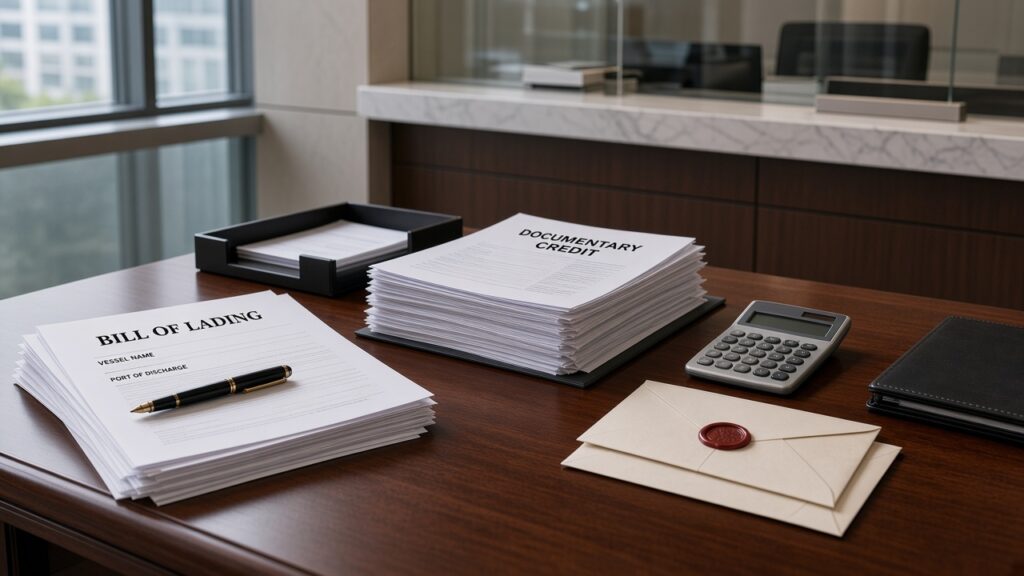
The required documents are specified in the LC itself, but a standard set for a China sea freight shipment typically includes:
- Full set of original bills of lading: Issued by the shipping line, confirming the goods have been loaded on board
- Commercial invoice: Specifying the goods, quantity, unit price, and total value
- Packing list: Detailing the contents of each carton
- Certificate of origin: Certifying that the goods were manufactured in China (required for preferential tariff rates under trade agreements)
- Inspection certificate: If required by the LC — issued by a third-party inspection company confirming the goods were checked before shipment
- Insurance certificate: If the goods are insured under CIF terms
The documents must match the LC terms exactly. Even minor discrepancies — a misspelled company name, a description that differs from the invoice, a date outside the validity period — give the issuing bank grounds to refuse payment. This is called a “discrepancy” and it is the most common complication in LC transactions.
What Are the Risks With Using an LC?
- Document discrepancies: If the seller presents documents with errors, the bank may refuse to pay until the discrepancies are resolved or the buyer approves a waiver. This can delay payment significantly.
- LC does not guarantee goods quality: An LC pays against documents, not goods. A seller can present a compliant bill of lading for a shipment of incorrect or low-quality goods. An LC is a payment guarantee, not a quality guarantee.
- Administration cost and complexity: Opening and managing an LC involves bank fees, careful attention to document requirements, and coordination between the buyer, their bank, the seller, and the advising bank. It is more complex than a simple wire transfer.
- Capital tie-up: Issuing banks typically require the buyer to maintain collateral or a credit line equivalent to the LC value.
For buyers who want to verify what a supplier has actually shipped before the payment window closes, an independent pre-shipment inspection provides a check that an LC alone does not. MandarinDesk’s Pre-Shipment Inspection coordination service arranges a third-party inspector at the factory before goods are loaded — giving you a documented report of what was actually shipped, independent of the shipping documents.
Related reading
Need a hand?
Tell us what you need done in China. We reply within 24 hours with a fixed price and timeline.
Get a free quote →