Private Label Manufacturing in China: How to Find a Factory, Set Your MOQ, and Protect Your Brand
Private label means selling a product made by a Chinese manufacturer under your own brand name. It is the fastest path from idea to shelf for most consumer goods — but only if you understand the factory selection process, what to put in writing, and how to avoid the IP risks that derail most first-time private label buyers.
Key facts at a glance
• Private label = your brand, someone else’s factory; the manufacturer produces to your specifications under a contract
• Different from OEM (you provide design/tooling) and ODM (factory owns the design, you rebrand it)
• Minimum order quantities (MOQs) for private label in China typically start at 300–1,000 units depending on the product category
• You need an NDA, a purchase order with spec sheet, and trademark registration before your first production run
• Alibaba, 1688.com, and Global Sources are the main starting points; a sourcing agent speeds up factory vetting
What is private label manufacturing, and how is it different from OEM and ODM?
Private label manufacturing means a factory produces goods to your specifications and ships them without its own branding — you apply your label, logo, and packaging. The key distinction is who owns the product design and who owns the brand:
For most first-time importers, private label is the right starting point. You are essentially selecting an existing product the factory already makes well, negotiating to put your branding on it, and focusing your energy on marketing and differentiation rather than product engineering. OEM becomes relevant when you have a proven product and want unique features competitors cannot copy.
How do you find a private label manufacturer in China?
The three main sourcing channels are:
- Alibaba.com: The largest B2B marketplace for English-speaking buyers. Use the “Private Label & Customization” filter when searching. Look for factories with Trade Assurance, 3+ years on-platform, and verified supplier status. Response rate and reply speed are good early quality signals.
- 1688.com: Alibaba’s domestic Chinese platform, which lists factories at lower prices than the export-facing Alibaba. It is in Mandarin and requires a Chinese payment method, which is why most foreign buyers use a sourcing agent to access it.
- Global Sources: Better for electronics, mobile accessories, and hardware than Alibaba. Its annual trade shows in Hong Kong attract serious manufacturers rather than trading companies.
- Trade shows: The Canton Fair (Guangzhou, April and October) and Yiwu International Trade City are the best in-person options for meeting factories. A single day at Canton Fair can yield 20–30 supplier contacts across your product category.
What is the step-by-step process for private label in China?
Write a product spec sheet: dimensions, materials, weight, color options, packaging requirements, compliance certifications needed (CE, FCC, CPSC, etc.), and any performance standards. The more specific, the more useful supplier quotes will be.
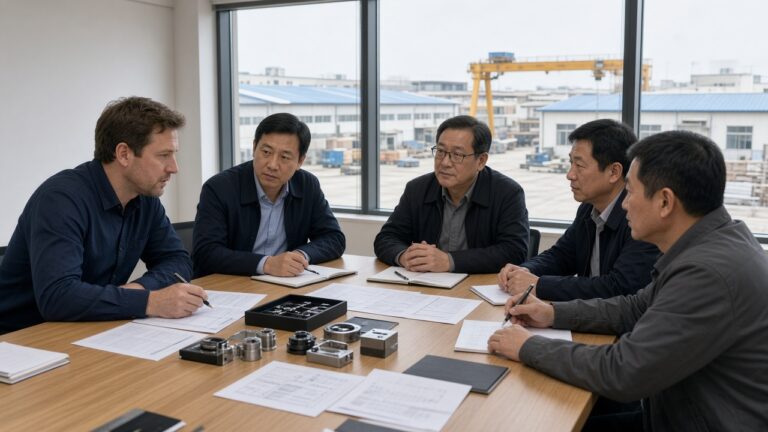
Use Alibaba, 1688, or Global Sources to identify candidates. Filter for manufacturers (not trading companies), minimum 3 years operating, and verifiable factory location. Send the same RFQ (Request for Quotation) to each so you can compare apples to apples.
Never place a production order without first approving a sample. A pre-production sample (PPS) tests the factory’s ability to match your spec; a production sample (PS) confirms the final product before full production begins. Budget $50–$300 per sample including shipping.
Before sharing proprietary designs, packaging artwork, or brand identity, have the factory sign a non-disclosure agreement (NDA). Your purchase order should reference your spec sheet, state the agreed price, payment terms, delivery timeline, and quality acceptance criteria.
A pre-shipment inspection (PSI) by a third-party QC firm verifies the production batch meets your spec before it is loaded for shipping. Catching a defect in China costs $300 for an inspection; catching it at your warehouse after customs costs $3,000–$30,000 in returns, relabeling, or disposal.
Register your trademark in China (through CNIPA) before you place your second or third order. Chinese law uses a first-to-file system — if your factory or a competitor registers your brand name in China before you do, they can legally stop you from using it on products exported from China.
What minimum order quantity (MOQ) should you expect?
MOQs for private label products from China vary widely by category and factory size:
- Consumer goods (cosmetics, supplements, apparel accessories): 300–1,000 units per SKU
- Electronics and tech accessories: 500–2,000 units; custom PCB or firmware development pushes MOQ higher
- Toys and children’s products: 500–3,000 units; compliance testing (EN71, ASTM F963, CPSC) is mandatory and adds 4–8 weeks
- Household goods, kitchen, home décor: 200–500 units; some categories have very low MOQs on established factory molds
- Custom packaging (boxes, bags, inserts): 500–2,000 units for custom print; this often drives the overall order MOQ
How to negotiate a lower MOQ on your first order
Factories set MOQs based on production run efficiency and material waste. To negotiate down: (1) offer a higher unit price in exchange for a lower quantity — framing it as “I’ll pay more per unit” is more effective than simply asking for less; (2) accept standard colors or stock packaging on the first order and add customization on subsequent orders once volume grows; (3) point to realistic growth projections — factories respond to the total relationship value, not just the first PO. Never ask a factory to lower MOQ without offering something in return.
What IP risks do private label buyers face in China?
Intellectual property protection is the most underestimated risk in China private label. The main concerns:
- Factory selling your design to competitors: Without an NDA and design exclusivity clause, the factory can supply identical products to other buyers. Exclusivity clauses are negotiable but require higher order volumes.
- Trademark squatting: Chinese factories or third parties register foreign brands in China before the legitimate owner does. This has affected major Western brands and small private label sellers alike. Register in China even if you do not plan to sell there — exports from China can be blocked at customs if someone else holds your trademark.
- Mold and tooling ownership: If you pay for custom molds or tooling, specify in writing that tooling ownership transfers to you at payment. Otherwise the factory may claim ownership and charge you again on the next order or refuse to release the molds if you switch suppliers.
Avoid “factory direct” Instagram or TikTok claims without due diligence
Many suppliers advertising “private label direct from factory” on social media are trading companies, not manufacturers. Trading companies add a margin (typically 10–30%) and have less control over quality. Ask directly: “Is your company the actual manufacturer of this product?” and request the business license (营业执照), which will show whether the entity is a trading company (贸易公司) or a manufacturing company (制造公司). A site visit or factory audit removes all ambiguity.
Frequently asked questions
Private label sourcing from China requires getting three things right simultaneously: the right factory, the right contract, and the right quality oversight. At MandarinDesk, we handle factory sourcing, supplier verification, NDA management, sample coordination, and pre-shipment inspection for buyers at every stage — from first-time private label importers to established brands adding new SKUs. Contact us to discuss your private label project.
Related reading
Need a hand?
Tell us what you need done in China. We reply within 24 hours with a fixed price and timeline.
Get a free quote →