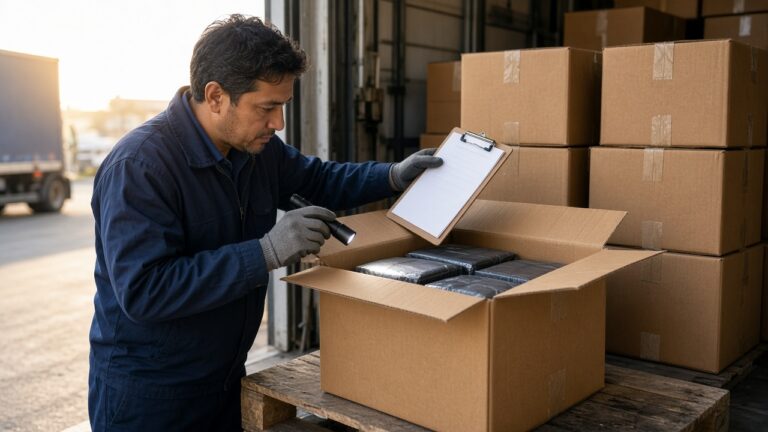
Manufacturing Traceability: How to Track Your China-Made Products From Raw Material to Shipment
When a product defect is discovered after shipment, the difference between a targeted recall and a total recall often comes down to whether you have traceability. Here is what manufacturing traceability involves, what to require from Chinese factories, and how to implement it without adding months to your timeline.
Key facts at a glance
• Manufacturing traceability is the ability to track the history, application, and location of a product through the supply chain
• Two directions: upstream traceability (raw materials → factory) and downstream traceability (factory → customer)
• Minimum system: batch/lot numbers on all units linked to production records at the Chinese factory
• Required for: food, supplements, pharmaceuticals, medical devices, electronics with UL/CE marks
• EU Product Liability Directive and US food safety regulations impose traceability obligations on importers, not just manufacturers
What is manufacturing traceability?
Manufacturing traceability is a documented system that connects a finished product to its production history — which raw materials were used, when they were processed, which workers operated which equipment, and what quality checks were performed. When a problem is discovered in a product after it has shipped, traceability determines which specific units are affected, enabling targeted corrective action rather than a costly blanket recall.
For importers sourcing from China, traceability has two distinct components: what your Chinese factory records during production, and what records you hold as the importer of record. Both matter — a factory with excellent batch records you have never requested does not give you traceability.
What does upstream and downstream traceability cover?
Factory records: supplier identity, lot numbers from raw material suppliers, incoming CoAs, inspection records. What you need: supplier list for your product’s specific materials.
Factory records: batch manufacturing records (BMR), production date, equipment used, in-process QC results. What you need: batch/lot number for every production run.
Factory records: AQL inspection results, PSI report, any lab test certificates. What you need: inspection report linked to lot number.
Factory records: which cartons contain which lot numbers, label version applied, barcode verification. What you need: carton content list with lot numbers.
Your records: commercial invoice, packing list, B/L, customs entry — all referencing lot numbers. What you need: document set linking shipment to production batch.
Your records: which lots went to which customers or Amazon FBA centers. What you need: distribution log linking lot numbers to recipients.
What is the minimum traceability system to require from a Chinese factory?
- Lot/batch numbers on every carton: Each production run must have a unique identifier marked on outer cartons and (for consumer products) on inner packs or unit labels
- Batch manufacturing records (BMR): A document for each production run recording materials used (with their lot numbers), quantities, production date, operator, equipment, and QC checks performed
- Packing list with lot breakdown: The factory’s packing list should state which lot numbers are in which cartons — not just quantities
- Retention samples: For regulated products (supplements, pharmaceuticals), the factory should retain samples from each production batch for the product’s shelf life plus one year
What traceability do US and EU regulations require from importers?
- US FDA Food Safety Modernization Act (FSMA): Traceability recordkeeping is required for high-risk food categories under the Food Traceability Rule (21 CFR Part 1 Subpart S), effective January 2026. Importers must maintain Key Data Elements (KDEs) linking each lot to its critical tracking events (CTEs).
- US supplement (21 CFR 111): Importers who label dietary supplements must maintain batch production records and distribution records for 1 year beyond product shelf life.
- EU Product Liability Directive (2024): Importers bear product liability for EU-market products; traceability records are essential evidence in liability disputes.
- EU General Product Safety Regulation (GPSR, effective 2024): Importers must be able to identify any economic operator in the supply chain and cooperate with market surveillance.
Include lot number requirements in your purchase order
Traceability starts at the purchase order. Specify in writing: (1) each carton must display a lot number matching the production batch, (2) the packing list must show which lot numbers are in which carton quantities, (3) the factory must retain batch manufacturing records for X years. Chinese factories that are not used to these requirements will often omit them unless specified contractually — and retrofitting traceability after goods have shipped is typically impossible.
Third-party sub-contracting breaks traceability
A common traceability failure point in China-origin manufacturing is undisclosed sub-contracting. Your factory passes work to a sub-supplier you have not approved, the sub-supplier has no traceability system, and your batch records no longer trace back to the actual production source. Include a prohibition on undisclosed sub-contracting in your supplier agreement and require the factory to disclose any sub-contracted work before it occurs.
Frequently asked questions
Setting up an effective traceability system for China-origin products requires coordination between your purchase order terms, factory documentation procedures, and your own import records. MandarinDesk helps buyers establish traceability requirements with their Chinese suppliers and verify that production records are maintained correctly. Contact us to discuss your supply chain documentation requirements.
Related reading
Need a hand?
Tell us what you need done in China. We reply within 24 hours with a fixed price and timeline.
Get a free quote →